The AI Ouroboros
Published at 2026-02-255 min read885 words Licensed under CC BY-NC-SA 4.0 artificial intelligenceeconomicswritingpersonal 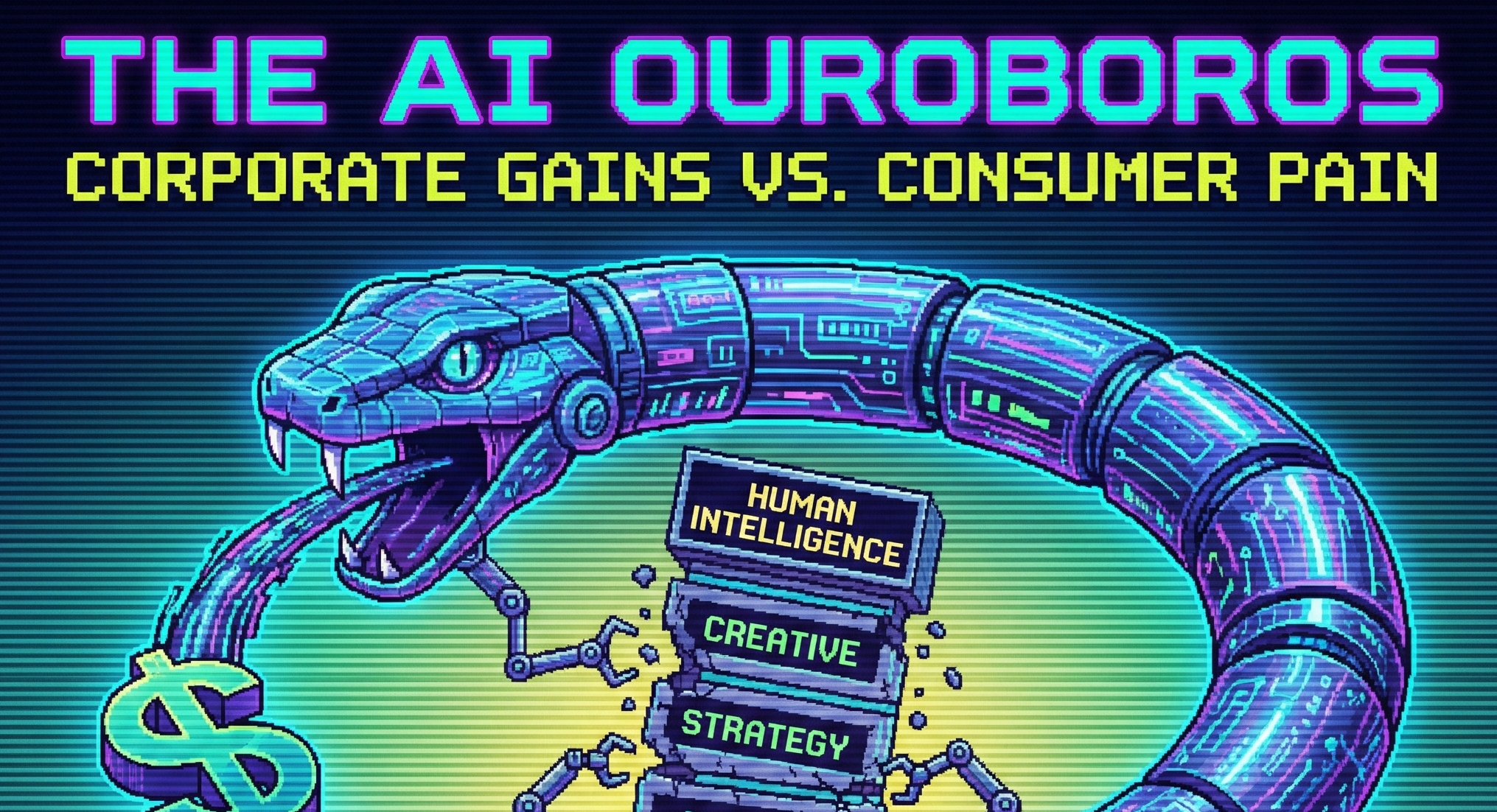
Or: The Market Discovers That Humans Were Load-Bearing
I read Citrini Research's "The 2028 Global Intelligence Crisis" piece.
Core tension: AI bullishness for corporate margins and AI bullishness for the economy may be contradictory. The productivity gains that send earnings screaming upward are the same gains that vaporize the consumer spending base those earnings depend on.
It is an ouroboros.
The mouth is very pleased. The tail has concerns.
The reflexivity trap: Companies threatened by AI become its most aggressive adopters.
This is individually rational. Individually. Each firm follows the same script: cut headcount. Reinvest the savings into AI. Maintain output at lower cost. Repeat. Repeat. Repeat.
Collectively, it's a death spiral with no natural brake. A coordination failure so elegant it could hang in a gallery, and people would gawk at its price and not the artwork.
The correlated bet problem: Mortgages underwritten against white-collar salaries, SaaS valued on "recurring" revenue, private credit structured around ARR. All are levered to the same assumption: human intelligence stays scarce.
And if it doesn't?
Then everything breaks at once. The mortgage, the multiple, the covenant. These aren't three risks. They're one risk wearing three suits.
Last time the assumption was "housing prices don't fall nationally." This time it's "knowledge work can't be automated at scale."
Same energy. Same blind spot. Same magnificent, stupid confidence.
Intermediation risk is under-appreciated. Trillions rely on layers upon layers of people whose entire value proposition is: "You are too busy or too confused to do this yourself."
The machines are neither busy nor confused.
An entire economic system built on the profitable stupidity of the end user. Except now the end user has an agent that doesn't get tired and doesn't take a 15% cut for sending an email.
Habitual app loyalty doesn't exist for machines.
Machines don't have habits, baby. Machines don't have a sunk cost fallacy. They evaluate and they switch, every single time.
That thing you people in SaaS call "stickiness" and "switching costs"? Yeah, you're introducing a buyer that doesn't experience inertia.
"But new jobs will be created!" Ah, the counterargument. This is the part where 200 years of precedent snaps in half like a dry twig: previous automation eliminated tasks. Tasks are specific, bounded, and mechanical. AI doesn't automate tasks. It automates thinking.
Think of the entire history of automation as a building. A tall one. Every floor is a type of work.
- Ground floor: physical labor.
- Second floor: routine cognitive work.
- Third floor: complex knowledge work. Analysis. Strategy. Writing. Coding. Things that require a degree.
- Top floor: abstract reasoning, creativity, judgment. The place where they said machines could never reach because it requires soul or intuition.
For 200 years, every time a machine automated one floor, humans rode the escalator up to the next one. Machines took the farm. People moved to factories. Machines took factories. People moved to offices. Machines took offices. People moved to knowledge work. Always up. Always toward more complexity, more abstraction, more thinking.
There was always a higher floor to escape to.
Now AI is automating the top floor. The thinking floor. The floor that was supposed to be the final refuge.
The question that should be keeping people up at night is:
Where do you go when the highest floor is automated? There is no floor above it. The escalator doesn't lead anywhere.
The escalator is still running. You can hear it humming. But now it goes down. Toward simpler work. Toward less pay. Toward roles that exist not because humans are better, but because humans are cheaper. For now.
Grab your parachute.
The private credit angle is the scariest structural risk.
$2.5 trillion market. Meaningful software exposure, PE-backed SaaS deals underwritten at mid-teens growth assumptions. The structures look solid, right?
The "permanent capital" cushion. Let's see what "permanent" and "capital" really mean in this context.
Oh god, it's insurance company annuity deposits. That's what's backstopping this. Not sovereign wealth funds. Not sophisticated risk capital with teams of quants and tail-risk hedges. Annuity deposits. Household savings. Retirement money.
Somewhere in Ohio, a retired schoolteacher checks her annuity statement and sees a number that makes her feel safe. The number is lying.
The question we must ask every startup and every business has just massively changed:
Does this business monetize genuine value creation or friction?
Because friction is dying.
Friction is what AI eats for breakfast.
How "recurring" is recurring revenue when agents renegotiate every contract?
When the buyer is a machine that benchmarks every renewal against every competitor in real time, with zero loyalty and perfect memory? "Recurring" revenue becomes "revenue that recurs until something 0.3% better shows up."
You know how this ends, don't you? You've read enough history. You've seen enough cycles.
And it won't matter. It never matters. We will sleepwalk into it. We will sleepwalk into the scenario we had time to prepare for, because preparing would require coordination, and coordination would require admitting the problem, and admitting the problem would crater the stock price, and the stock price is everything.
And so we don't.
A tale as old as time.
Beauty and the beast. Except this time, the beast is a language model, and beauty is a $2.5 trillion private credit market that forgot to hedge.